

By Nistha Trehun, founder of Kitty Party in Berlin, Workplace Happiness Coach and certified Laughter Yoga Leader. 300+ team events for 50,000+ people over more than seven years, including teams at Google, Meta, LinkedIn and Amazon.
Quick answer: The virtual team building activities that work best are the ones where everyone does something with their hands or answers together: a live cooking class, a mocktail or warm drink workshop, a spice tasting, custom trivia, laughter yoga or a happiness workshop. They run in 60 to 90 minutes on Zoom or Teams, scale from 10 to 1,000 people, and connect colleagues in Berlin, the rest of Europe and the USA in one session.

Kitty Party has hosted online events for teams at companies such as Google, Meta, LinkedIn and Amazon, for groups from 10 people up to 1,000. These are the formats that keep cameras on and people talking, plus a few ideas you can run yourself without a host.
When Berlin went into lockdown in 2020, my onsite events were cancelled one after another. I decided to try hosting online, and it turned into a whole new part of the business. I started with 90-minute sessions and soon moved most of them to 60 minutes, because people already spend all day on screens. That is still my first piece of advice: shorter, simpler and more hands-on than you think.
Key Takeaways
Choose activities where people do something, not just listen.
Match the format to the goal: celebrate, energise, connect or build team culture.
Keep instructions simple. Online, the host cannot check everyone's kitchen.
Short sessions every two to three months keep remote teams connected better than one big event a year.
Plan for time zones and send materials a week ahead.
Why Virtual Team Building Still Matters
Remote and hybrid work removed the coffee machine conversations that used to build trust. Without them, people know their colleagues only as names in a chat. A good virtual activity gives teams a shared experience to talk about, shows colleagues a side of each other that meetings never do, and makes it easier to ask for help afterwards. In our online events, children, partners and pets often join in, and colleagues see each other at home for the first time.
Hosted Virtual Team Building Activities
1. Online cooking class with the Dancing Chef
Everyone cooks the same dish in their own kitchen, step by step, with music and dance breaks. Dishes such as butter masala, cumin potatoes and flatbreads use ingredients from any local supermarket, so it works in Berlin, London or Chicago. Vegan and allergen-friendly versions are available.
I have taught cooking to people from many countries since 2013, starting in South Korea. One thing I learned early: every culture has its own relationship with ingredients. Some people never cook with onion or garlic, others have never used chilli. So every recipe comes with simple swaps, and I explain even small things, like how much a pinch really is.
2. Mocktail and warm drink workshop
Teams shake mocktails such as homemade ginger ale in summer and make spiced chai, golden turmeric latte or hot chocolate in winter. Everyone can join, and the ingredient list is short.
3. Smoothie session
A fresh, colourful format that works as a morning kick-off or an afternoon energy boost, with stories about the ingredients.
4. Virtual dessert workshop
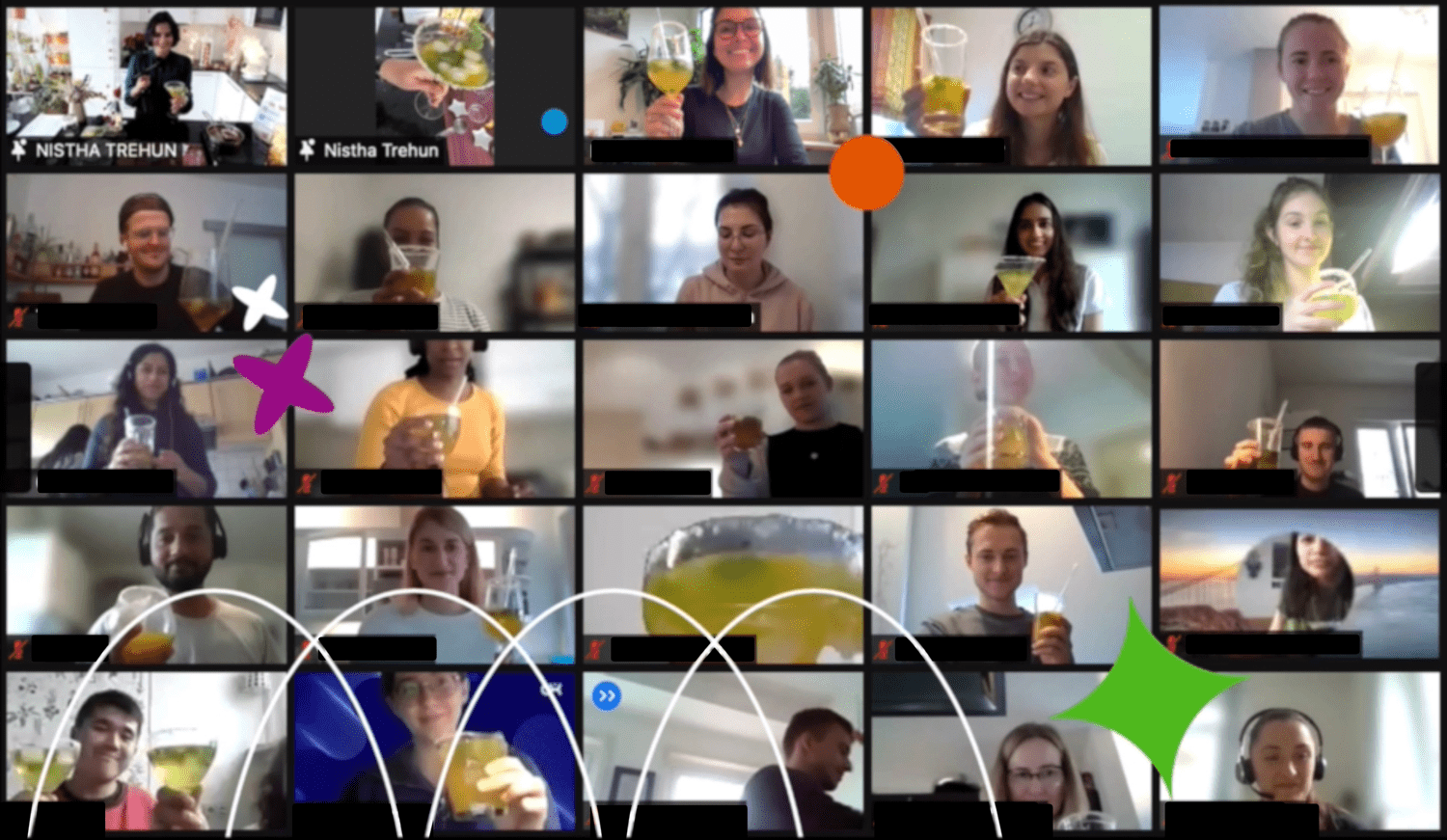
Colourful, creative and easy for beginners. A favourite for celebrations and milestones, and everyone has something beautiful to hold up to the camera at the end.
5. Spice tasting
Teams explore spices from their own kitchen cupboards and learn the stories behind them. Participants can choose which spices we talk about, so no two sessions are the same. A calm, sensory format that suits teams who prefer conversation to competition.
See the virtual spice workshop
6. Custom trivia with dancing
Rounds built around your company, your industry or an occasion, with dance breaks between rounds. Answers can go in the chat, which suits shy colleagues. It is the format I recommend most often to teams new to virtual events: no ingredients, little preparation, and it works for 10 people or 500. Our trivia is built to feel like a party, not a test. People who know little about the topic still laugh, learn something and have a real chance to win.
Themes teams love:
Classic: pop culture, the 80s, 90s or 2000s, sports moments, geography and world cultures, film soundtracks and famous lines.
Company: your company history and inside jokes, your industry (famous slogans for a marketing team, inventions for engineers), and "who said it" using fun facts colleagues share in advance.
Occasions: Christmas, Diwali and Holi, International Women's Day, Employee Appreciation Day, and Bollywood with songs, stars and dance breaks. See Bollywood trivia for teams.
How a session runs (about 70 minutes):
Welcome, teams formed and rules explained: 5 minutes
Rounds 1 to 3, with picture and music rounds: 25 minutes
Dance break, one song, cameras optional: 5 minutes
Rounds 4 to 6, with a company round and a bonus round: 25 minutes
Scores, winners and a short wrap-up: 5 to 10 minutes
Sample questions: guess the city from a close-up of a famous building; name the song from the first five seconds; true or false, "The Berlin TV Tower is taller than the Eiffel Tower" (true, about 368 metres against about 330); "Which colleague once worked as a ski instructor?"; and a playful estimation question where the closest answer wins.
Tips for hosting trivia yourself:
Use breakout rooms so teams can discuss privately, in teams of four to six.
Mix easy and harder questions, so beginners and experts both stay in the game.
Use one answer channel, such as a form or chat thread, and show a countdown for each round.
Reveal answers after each round and add a fun fact. Show the scoreboard only halfway and at the end.
Give bonus points for creativity, not only for correct answers.
Offer small prizes: a voucher, a playful certificate or simply bragging rights.
A colleague can run a simple quiz for a small team. A host makes sense when the group is large, spread across time zones, or when the event is a celebration. The host handles questions, timing, scoring and energy, so organisers can play too. For 150 people or more, we add team captains and a co-host for scoring and technical support. The same format also works as a pub quiz in a Berlin office or at a company dinner, and in hybrid events with mixed office and remote teams.
7. Virtual laughter yoga
Twenty to 45 minutes of guided laughter exercises that lift energy across time zones. No experience needed, and it works for very large groups.
8. Virtual happiness workshop
Practical tools for happiness and connection at work, led by a Workplace Happiness Coach. Useful during busy periods, reorganisations or as part of a team or culture week.
See the virtual happiness workshop
DIY Virtual Team Building Ideas Without a Host
9. Two Truths and a Lie
Each person shares two true facts and one invented one. The team guesses the lie.
10. Kitchen scavenger hunt
Call out items to find at home within 60 seconds: something yellow, a spice from another country, your oldest mug.
11. Show and tell
Each person shows one object that matters to them and tells its story in one minute.
12. Shared playlist
Everyone adds one song to a team playlist and explains why. Play it during the next team meeting.
More quick ideas are in the icebreakers section below.
Ideas for Very Large Groups
With hundreds of people, the trick is to make the big room feel small:
Live polls: everyone answers at once and sees the results instantly.
Team bingo: cards with fun facts about colleagues or the company, marked off during the session.
Breakout coffee rounds: random groups of four to six for ten minutes.
Laughter yoga or trivia: formats where the whole group takes part at the same time.
How to Choose the Right Virtual Activity
Celebrate a milestone: cooking class or dessert workshop, 10 to 150 people
Quick energy boost: laughter yoga or smoothie session, 10 to 1,000 people
Connect new or mixed teams: custom trivia with dancing, 10 to 500 people
Build team culture: happiness workshop, 10 to 300 people
Low effort, no host: DIY games above, any size
Tips for Remote Teams in Europe and the USA
Choose a shared time. 16:00 to 18:00 in Berlin is 10:00 to 12:00 on the US East Coast.
Send the shopping list a week ahead. Keep ingredients simple and offer swaps.
Keep it to 60 to 90 minutes. Energisers can be 15 to 30 minutes.
Use breakout rooms. Small groups of four to six talk more.
Run it regularly. A short session every two to three months keeps connections alive.
Fit the Session to the Time of Day
Every team uses the same hour differently. Some teams cook a full lunch with us, some make dinner, and some only have time for a mocktail at the end of the day. Colleagues in the USA or Asia sometimes join very early in the morning or straight after a meeting. So I plan each session around the time of day: a shorter dish at lunchtime, a full meal in the evening, a drink or a quiz when people are tired. People who prefer to watch and learn quietly are just as welcome as those who cook along.
A Story Round for International Teams
In mixed teams, ask each person to share one short story or tradition from where they grew up, with a photo or an object if they like. It takes 15 minutes, needs no host and often becomes the part of the meeting people remember.
How Often Should Remote Teams Meet Like This?
From experience, the rhythm matters more than the size of each event. A simple plan for a remote team:
Every week: icebreaker or check-in at the start of a team meeting, 5 to 10 minutes
Every month: virtual coffee pairs or a short game, 15 to 30 minutes
Every quarter: hosted activity such as cooking, drinks, trivia or laughter, 60 to 90 minutes
Once a year: larger celebration, online or hybrid, 90 minutes or more
What Makes a Virtual Activity Work
Cameras on, but not forced. Hands-on activities give people a reason to show their screen.
Something to show at the end. A dish, a drink or a score creates a shared moment. Presentation matters: we eat with our eyes first.
Small groups. Breakout rooms of four to six people let everyone speak.
A host who knows the room. Calling people by name and inviting them in keeps energy up. I repeat key instructions several times, because someone always joins late.
A clear end. Finish on time, ideally with a shared toast or photo.
Virtual Team Building for Different Seasons
Winter: warm drinks, cooking, Christmas trivia. See virtual Christmas party ideas.
Autumn: Diwali cooking and Bollywood trivia. See Diwali celebration ideas.
Spring: International Women's Day talks and workshops.
Summer: smoothies, mocktails and homemade ginger ale.
Measuring Whether It Worked
Ask three short questions afterwards: Did you enjoy it? Did you talk to someone new? Would you join again? Most teams also notice softer signs: more cameras on in the next meetings and more informal chat in team channels.
Quick Icebreakers to Open Any Call
Before the main activity, five minutes are enough to warm up the room:
One-word check-in. Everyone describes their mood in one word.
This or that. Coffee or tea, mountains or sea. Everyone types the answer in the chat at the same moment.
Rose and thorn. One good and one hard moment from the week. Keep it light and let people pass.
Desert island. One item you would take and why.
Emoji status. Post the emoji that fits your day. Perfect for people who prefer not to speak.
Running It as a Hybrid Event
Many teams now meet half in the office and half at home. Three set-ups work well: offices plus remote colleagues, small local hubs led by one colleague, or several offices connected in parallel. A few rules make the difference:
Make sure remote colleagues can hear the room clearly.
Mix teams across locations, so offices do not compete against each other.
The host speaks to the screen as much as to the room.
Choose an activity that needs no special equipment in any one office.
Check the time zones, so nobody joins at 7 in the morning.

Frequently Asked Questions
What is the most engaging virtual team building activity?
Activities where everyone makes something at the same time, such as a live cooking class or drink workshop, keep people engaged because cameras stay on and everyone has a result to show.
How long should a virtual team event take?
60 to 90 minutes. Energisers can be 15 to 30 minutes.
Can families join?
Yes. In cooking and drinks sessions, children and partners often help, and it makes the event more personal.
Can you host teams in the USA?
Yes. Sessions are scheduled for US time zones and run in English.
Can trivia questions be about our company?
Yes. Custom rounds use facts you share in advance, such as milestones, products and fun facts about colleagues.
What if some colleagues know nothing about the trivia theme?
That is fine. Questions are written for all levels, and multiple choice rounds give everyone a fair chance.
Which platforms do you use?
Zoom, Microsoft Teams, Google Meet or Webex.
What does a team need to prepare?
A laptop or tablet and the items on the shopping list. For trivia and laughter sessions, nothing at all.
Book a Virtual Team Event
Tell us about your event and get a tailored offer within 24 hours.